
What to Look for in a Construction Contractor: A Guide for Developers and Project Owners
Selecting a construction contractor is one of the most consequential decisions a developer or project owner makes. The cost of a poor choice is not only financial: delayed programmes, quality deficiencies, and coordination failures can all be traced back to a contractor that lacked the capabilities, certifications, or organisational structure the project required.
This guide sets out the questions worth asking before appointing a contractor for a civil or industrial construction project in Hungary or elsewhere.
1. What disciplines does the contractor cover?
The first question is not the price — it is the scope. For straightforward refurbishment work, a single-trade specialist may be sufficient. For more complex projects involving civil superstructure, MEP systems (mechanical, electrical, and plumbing), and interior finishing, the central question is whether these disciplines are delivered by one organisation or by separate subcontractors.
Fragmented delivery carries coordination risk: every handover point between contractors is a potential gap, delay, or dispute over responsibility. A contractor that integrates multiple disciplines provides single-point accountability across the full scope.
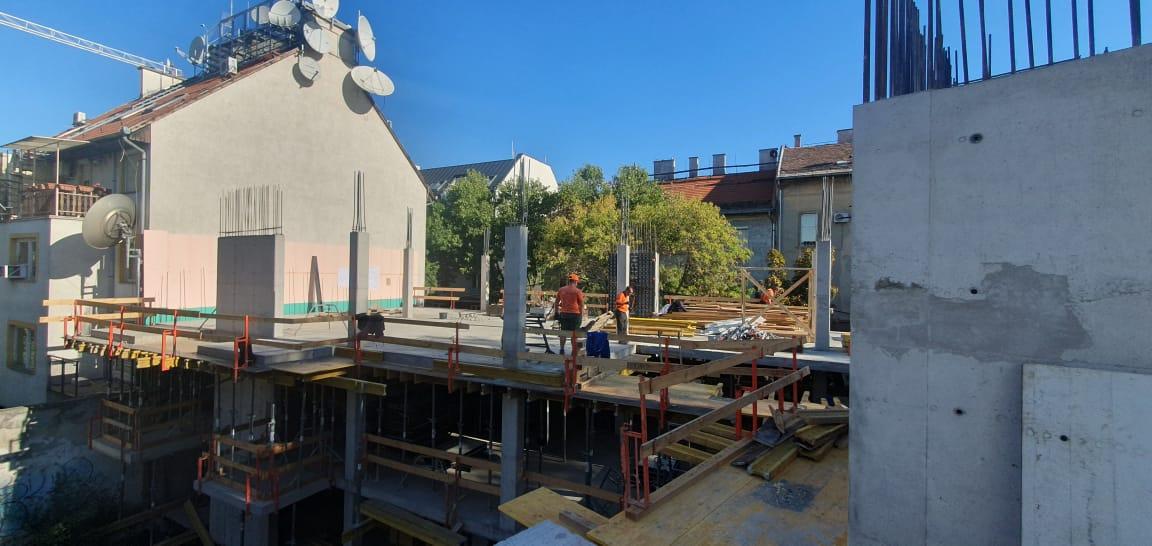
MECC Group delivers civil construction, industrial construction, and MEP within a single group structure. This model is applied in Budapest: on the MOR 21 residential project, every phase from superstructure to MEP installation and interior finishing is carried out by MECC.
2. Does the contractor hold valid quality management certification?
A quality management certification — particularly ISO 9001 — is not merely an administrative requirement. It means the contractor's processes are regularly audited by an independent body and verified against an international standard. For the client, this means quality expectations are enforced through documented and controlled processes, not through the contractor's goodwill.
The question worth asking: is the certification current, and what does it specifically cover?
MECC Group holds the following certifications:
ISO 9001: Quality Management
ISO 14001: Environmental Management
ISO 45001: Occupational Health & Safety
ISO 50001: Energy Management
3. What is the contractor's track record in the relevant project type?
Completed projects are the most reliable measure. It is worth verifying whether the contractor has delivered work of a similar type and scale, and whether real documentation — photographs, completion dates, locations — is available to support those claims.
General considerations by project type:
Residential buildings: Does the contractor have demonstrated experience in full-cycle civil construction, from excavation through to completion?
Commercial and office projects: Is there a reference base of fit-out work completed to a comparable standard and function?
Industrial projects: Does the contractor have verifiable experience in steel structures, piping systems, or electrical and SCADA installations?
MECC Group's Budapest portfolio includes the following completed and ongoing projects:
MOR 21 Apartment (Budapest, 2026-2027): 23-unit boutique residential building, currently under construction. Live log: m21apartments.com
Nagy Fuvaros 25 (Budapest, 2026): residential civil construction, currently under construction. Live log: nf25apartments.com
Kitikate Clothing (Budapest, 2024): retail fit-out
Tantuni House (Budapest, 2023): restaurant fit-out
Bistro Dash Cafe (Budapest, 2021): cafe fit-out
Beyond Hungary, MECC has completed nine projects in Azerbaijan since 2017, including the Grand Hotel Seabreeze hospitality civil works, the Liman Clinic healthcare construction, and the Azercell Khazar Center corporate fit-out at Port Baku.
4. How does the contractor manage health and safety and environmental compliance?
Health and safety management and environmental compliance are not only legal obligations — they are part of a project's risk profile. A safety incident or environmental breach can cause delays, fines, and reputational damage that affect the project owner directly.
ISO 45001 (occupational health and safety management) and ISO 14001 (environmental management) indicate that a contractor manages these areas through structured processes, not on an ad hoc basis.
5. How does the contractor communicate and report during the build?
Visibility into build progress is a basic expectation, not a premium service. On active projects, it is worth asking: how does the contractor keep the client informed of progress, emerging issues, and any proposed changes?
MECC Group maintains live construction logs for the MOR 21 and Nagy Fuvaros 25 projects at m21apartments.com and nf25apartments.com, documenting progress in real time. This level of transparency gives clients, prospective buyers, and partners a clear and current picture of work quality and programme.
6. What standards govern the contractor's work?
"Quality construction" on its own means nothing. The assessable question is: what specific standards does the work follow, and how are those standards verifiable?
MECC Group operates to European norms and Western practices across every market. That standard applies equally in Azerbaijan, Hungary, and Greece: the same processes, the same certifications, the same quality baseline.
Contact
MECC Group's Budapest office handles civil, MEP, and fit-out project enquiries across Hungary.
Address: Fay utca 1/B., Big Ben Plaza, 1135 Budapest
Email: office@mecc.hu\
Phone: +36 30 462 50 80
For project enquiries, the team will ask for: project location, type, approximate scale, and timeline.
You Dream, We Built!